

Netanyahu Is Still Running as the Guarantor of Security
As I write this, Benjamin Netanyahu is speaking to the UN General Assembly. His arrival in the chamber was greeted with a mass walkout by delegates who refuse to listen to Israel’s side of the story. Whatever issues I have with Netanyahu’s current government and with the security failures of October 7 which took place on his watch, there are few people who are better at articulating Israel’s case on the world stage.
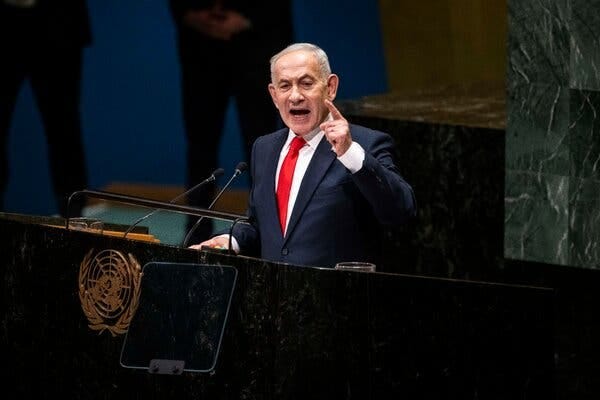
Image: Israeli PM Benjamin Netanyahu Addresses the UN General Assembly: Sept 24, 2026 — Source: Dave Sanders for the New York Times
For twenty five years Netanyahu’s political fortunes have risen whenever Israel’s sense of security has been undermined. Over the years, he has skillfully mobilized Israeli nationalists to maintain his grip on power. He has coopted Israeli centrists in the name of national unity and outmaneuvered them to ensure they never took power. In the past four years he has managed to maintain a coalition between non-Zionist ultra-orthodox who do not want to serve in the army and religious nationalists for whom army service is a core value. He did it without ever delivering the statutory exemption to military service that he promised in order to bring the ultra-orthodox parties into the government.
But Netanyahu could never have enjoyed such a long stretch of political success, if the actual threat to Israel hadn’t been steadily growing. He took power originally in 1996 only because a wave of Hamas terrorism derailed the election campaign of Shimon Peres, who was riding a huge wave of sympathy in the wake of the assassination of Yitzchak Rabin.
He took power again in 2008, in the wake of the perceived failures of the second Lebanon war, and the disappointing outcome of Ariel Sharon’s unilateral withdrawal from Gaza. Netanyahu’s credibility rises as the credibility of Israel’s adversaries falls. The hypocrisy of Israel’s critics in the west may be ignored by many in the mainstream in Europe and here in Canada, but Israelis are acutely aware of the chasm between the way Israel has been depicted in the international media, and the reality of the place where they live. Netanyahu skillfully called attention to this hypocrisy today at the UN.
Israel was traumatized on October 7. Many former supporters blame Netanyahu for the catastrophe that began that day, and as a result, Likud continues to register in most polls, at a level one third lower than four years ago. In spite of this, Netanyahu was in his element today at the United Nations, reminding the world that Israelis have nowhere to go and that they have no choice but to win. The ever more absurd levels of hypocrisy displayed by the leadership of the UN is the perfect foil to the message which he delivered today. The UNGA podium provides him with the ideal backdrop for a campaign speech and Netanyahu made the most of it.
Netanyahu denounced Israeli adversaries and critics. He predicted that the Iranian people would prevail over their oppressors. He denounced Qatar for fueling the campaign of lying propaganda that has erupted in the west during the war, insisting that Israel is committing genocide. He refuted the genocide allegations using some of the same arguments that I’ve used many times in these pages. Genocide is an absurd accusation when it is directed at Israel. Its currency fuels support for Netanyahu as Jews in Israel and abroad perceive that the world’s policy toward Israel is driven by hatred rather than reason.
He pointed out that Turkey’s Erdogan denies the Armenian genocide (which Israel recently recognized), has massacred Turkish Kurds, invaded Syria and that Turkey has occupied Northern Cyprus for 55 years. He called New York’s mayor Mamdani an antisemite and said, “You tried to prevent me from coming here. You tried to silence me.”
Netanyahu addressed the question of “settler violence” by describing it as the behaviour of 150 juvenile delinquents. He claimed that he has no patience for it and that he has “put the Shin Beth” on the problem. He pointed out that while the world’s leaders are preoccupied with the issue, they ignore a far larger problem of Palestinian terrorism against Israelis in the same region. He praised “hundreds of thousands of peaceful settlers” who just want to go on with their lives without being menaced by thousands of attempts at violence foiled each year by Israel’s security services.
Fighting in Lebanon and Gaza Continues
In spite of ceasefires in Lebanon and Gaza, Israel continues with daily military action. These attacks are permissible in the context of the ceasefire agreements, which leave Israel free to act against violations by the other side. In Lebanon, Hezbollah restrains the Lebanese government from concluding a peace agreement with Israel and thwarts the efforts of the Lebanese army to take control of areas that Israel has pulled out of.
In this context Israel strikes daily, as Hezbollah tries to rearm and rebuild its military infrastructure. Hezbollah strikes with drones, missiles, and ambushes at the IDF periodically as they go about their work.
In Gaza, the refusal of Hamas to disarm has stopped progress in the peace process there. Israel continues to strike at members of Hamas who were involved in the attacks of October 7 and are still active now organizing violence against the IDF in Gaza. It is hard to imagine that killing bloody handed terrorists who are still operating with impunity in Lebanon and Gaza isn’t helpful to the government’s popularity.
Events in Judaea and Samaria also have an impact. The world’s eyes have been riveted on stories about Palestinians harassed and driven out by Israeli hooligans. For some Israeli voters, this reflects a failure of the existing government to maintain the rule of law in the territories. On the other hand, there have been a rising number of attacks on Jews in the territories as well, including some fatalities. In the past this has strengthened the government’s hand, as the IDF is seen to be acting forcefully against terrorists in the runup to the vote.
In this way, action by the security forces unavoidably has a political impact as well.
Latest Numbers Show the Government Trailing
In spite of this or because of it, the latest polls show that Israeli voters have an appetite for change.
On September 22, the Midgam polling organization released numbers which show the parties that make up the existing government would receive only 46 seats, with Likud at 20, United Torah Judaism at 8, Shas at 7, Otzma at 6 and Religious Zionism-Zehut at 5.
Among the opposition, Eisenkot’s Yashar leads at 23 seats, Bennet’s Yachad is second at 13, followed by Yisrael Beiteinu and Democrats at 9 each. This puts the core opposition eight seats ahead of the government at 54, seven seats short of a majority.
Ofer Winter’s new Anshei Yisrael (People of Israel) party polls at 4 seats in this poll. Winter’s views on security and territory are close to those of Otzma. So they would be expected to join a right wing government if Netanyahu could form one. The Reservists-Bew Economic Party also comes in it at four. They are more centrist and are a potential partner in a government led by Eisenkot. If we add these newcomers to the respective blocs we see the opposition at 58 and the government at 50.
The Joint List of Balad, Hadash and Ta’al would receive seven in this poll. These parties are unlikely to support a government led by Netanyahu or Eisenkot. The remaining five seats would go to Ra’am, led by Mansour Abbas. The Ra’am list includes former Yesh Atid MK and career police officer Yoav Segalovitz in second spot, the first Jewish person to run with Ra’am.
If Ra’am were to join an Eisenkot led government with all the other parties previously mentioned, this would give Eisenkot a majority with 63 Members of Knesset. Such a coalition is the only feasible government that excludes Netanyahu’s Likud. Given that Eisenkot and Bennett both want a government that will replace Netanyahu, such a coalition would make sense.
However, Bennett has also said that an Israeli government should not rely on the support of any Arab parties in the wake of October 7 massacre. He wants a government consisting entirely of Zionist parties, which would exclude both the ultra-orthodox UTJ and the parties of the joint list.
Whether Ra’am qualifies as a Zionist party is becoming an interesting question. Mansour Abbas acknowledged in the past that Jews are a majority in Israel and that the people he represents want to work within that reality. The addition of Yoav Segalovitz is meant to further show that Abbas wants to work constructively in government with Israeli Jews. On the other hand, the commission charged with supervising the current election, just ruled that Ra’am should be disqualified due to its alleged connections with the Muslim brotherhood, to which Hamas is also affiliated. This decision is subject to review by the Israel Supreme Court which has overturned such rulings in the past.
Ra’am was part of a previous Israeli government. This was the coalition which preceded the current one. This suggests that such a government including Ra’am might be possible. However, that previous government was short-lived, because members of its right flank began defecting only months into its term in office. An Eisenkot led coalition which excludes the parties of the current government and includes centre-right parties like Yisrael Beiteinu and Reservists, might be at risk of similar erosion.
That said, the possibility of any government led by Benjamin Netanyahu emerging from these results seems remote. In theory, Netanyahu might serve as a junior partner in a government led by Eisenkot. In such a coalition, Netanyahu might insist on a rotation arrangement for the job of Prime Minister, such as the one he negotiated with Benny Gantz a few years ago. Netanyahu found a way to renege on that deal, denying Gantz his turn in office, but Eisenkot as senior partner would presumably get to go first this time.
Yashar, Yachad, and Likud would together command 56 seats, with a number of centre-right parties available to provide the remaining seats necessary for a majority. Militating against this is the promise by the new opposition parties that they will provide a break with the existing leadership, tainted as it is by the catastrophe of October 7. This means that a coalition including Netanyahu’s Likud would be seen as a betrayal by many supporters of Yashar and Yachad. Given his sharp differences with the current government on the conduct of the war, it is unlikely that Eisenkot would agree to an arrangement that gives Netanyahu a chance to be Prime Minister again. If Netanyahu were to resign the Likud leadership after the election, such a coalition might become more feasible.
Five Weeks to Go
The Israeli election campaign still has five weeks to run. Netanyahu is no doubt hoping that his UN speech will lure some of the support he had four years ago back to his column. A better result for Likud would strengthen his hand in any coalition negotiation and further complicate the chances of forming a government that excludes Likud entirely.
World events may yet affect the attitude of Israeli voters as they have in the past.
My thanks to all my subscribers for your interest in Canadian Zionist Forum. As I have for more than three years, I will continue to bring you news and perspective. My goal is to deepen your understanding of Canadian Zionism and the latest developments affecting the State of Israel at this time of historic upheaval and change.
If you are a paid subscriber you can leave a comment. You have my special thanks.
If you would rather make a one-time gift you can an buy me a coffee.

Canadian Zionist Forum sends best wishes and thanks to all our readers. We are very grateful for your interest and support. Please share this article with someone who might appreciate it.
Hi, David. I've just resent it to your Yahoo email.
Hi, David. I sent you a piece in an email a week or so ago. Did you ever get it?